One-Stop Fragrance Manufacturing: What the Scope Is, What It Isn't
One-stop fragrance manufacturing sounds like a single responsible party for everything from brief to pallet — and for a new brand that is genuinely valuable. But the phrase covers different scopes at different factories, and the handovers inside it are where projects go quiet. The clarity you need is not marketing language; it is a written list of what is included, who is accountable, and who owns the assets when the project ends.
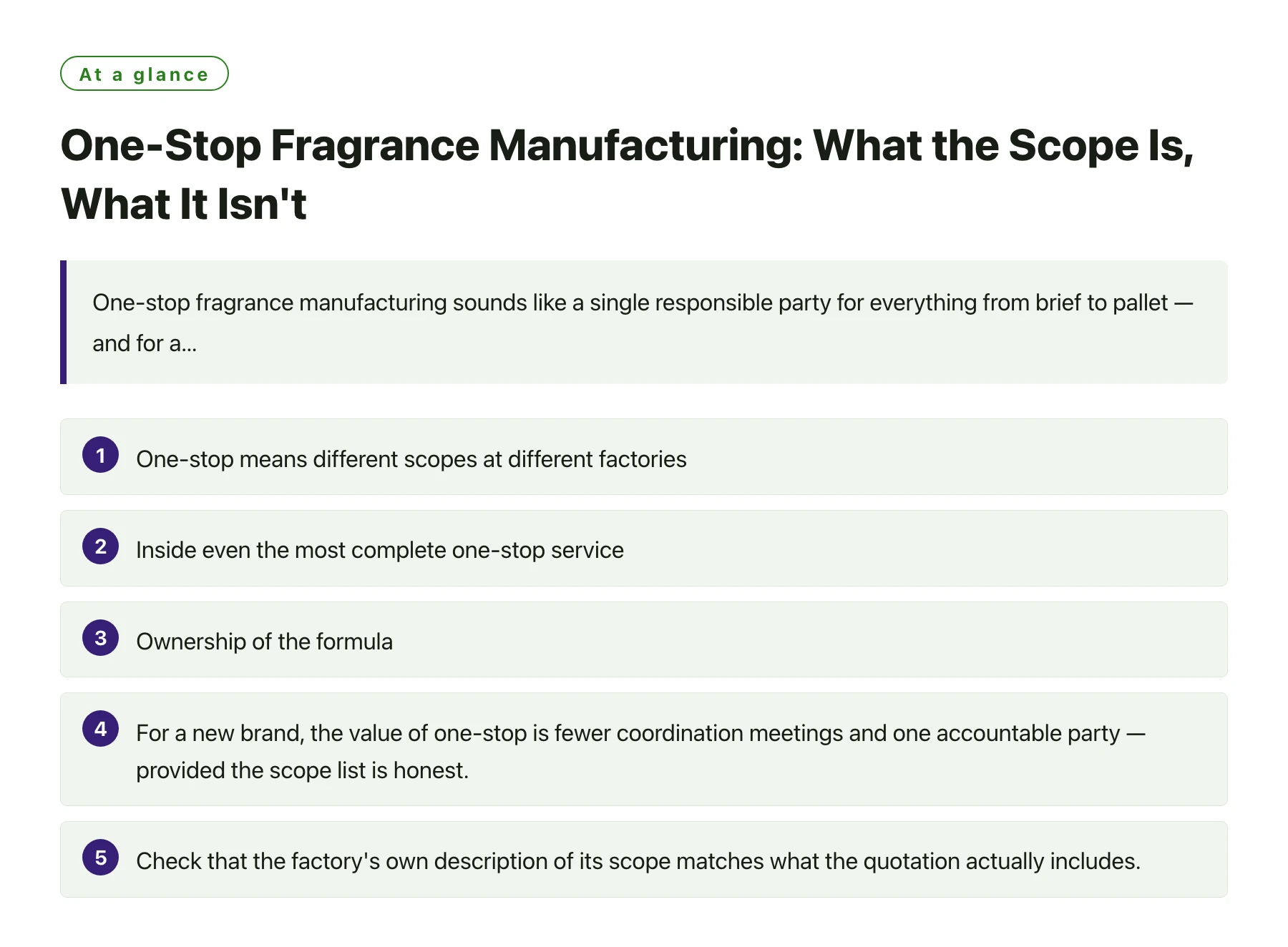
Key takeawaysOne-stop means different scopes at different factories, so the first question is always: what exactly is inside the offer? · Inside even the most complete one-stop service, handovers still exist between development, packaging, filling and logistics — and each one is a place where responsibility can blur. · Ownership of the formula, the mould and the design files should be settled in the same document as the price, because the launch is not the end of the relationship [1]. · For a new brand, the value of one-stop is fewer coordination meetings and one accountable party — provided the scope list is honest. · Check that the factory's own description of its scope matches what the quotation actually includes.
New brands face a fork early: build the fragrance, the bottle, the decoration, the filling and the box through separate suppliers, or put the whole project with one manufacturer. The one-stop route is attractive for the obvious reason — one schedule, one invoice, one phone number — but its usefulness depends entirely on how honestly the scope is defined.
This article maps what one-stop actually covers, where the hidden handovers live, and the points a new brand should pin down in writing.
What one-stop actually covers
At its most complete, one-stop fragrance manufacturing includes development of the scent, sourcing or design of the bottle and packaging, decoration, filling, assembly, quality control and export documentation. When all of that sits under one roof, a brand briefs once and the factory carries the project through.
The phrase also gets used for narrower offers: a factory with filling lines that partners for bottles, and a chemistry lab that partners for decoration, can still describe itself as one-stop. That is not dishonest — but it changes who holds your schedule, and you should know before you sign.
The test is simple: ask for the written scope of the quotation, line by line, and compare it with the factory's general description of its services. Where the general page and the quote disagree is where you ask the next question [1].
Where handovers still exist
Even inside a complete one-stop service, the project passes through distinct phases — development to packaging, packaging to filling, filling to export — and each pass is a handover. The difference from a split supply chain is that the handovers happen inside one organisation, which makes them faster and usually more honest, but they still need points of contact and agreed references.
Ask who manages the handover between stages and what the approval gate looks like. If the same project manager owns the project from brief to pallet, coordination risk drops sharply. If each stage has its own owner with no common thread, you are effectively back to a split supply chain with a single invoice.
One-stop versus a split supply chain
| Question | One-stop factory | Split suppliers |
|---|---|---|
| Number of schedules | One | One per supplier, coordinated by you |
| Who is accountable for the whole project | The factory | You, unless you hire a coordinator |
| Lead time risk | Internal handovers only | Supplier-to-supplier handovers plus your coordination |
| Documentation | One responsible party holds the file | You assemble and reconcile the file |
| Best fit | A new brand without a production team | A brand with its own team and specialist needs |
The honest framing: one-stop trades some control for coordination. If the factory's scope is real, that is a very good trade for a first launch; if the scope is narrower than advertised, you have paid for coordination you did not get.
The clarity a new brand should demand
Before signing, a new brand should demand four things in writing. First, the scope list: every step included, and everything excluded, in one page. Second, the approval gates: what you sign at each stage and what the reference is. Third, the schedule: dates per stage, not just a total lead time. Fourth, the ownership terms: formula, mould, design files and who holds them when the project ends.
Ownership terms deserve emphasis because they are rarely urgent at signing and always expensive later. The registration of industrial designs and trademarks is only useful if the brand holds the rights [1]. If the mould or the artwork stays with the factory, your product is not portable — a fact that should be on the table at the start, not discovered when you switch suppliers.
When evaluating, look at how the factory describes its own end-to-end service. The language behind one-stop fragrance manufacturing should match what the quotation contains; the discussion of one-stop scent development should explain the development-to-production handover rather than skip it. A house that names its full scope, from development and filling to packaging design — as Xuelei official website does when it lists its OEM/ODM, private label and packaging services — makes the verification conversation much easier, because you can hold its public description against its quote.
Finally, remember what one-stop does not remove: your product still has to be compliant in your market, and the documentation is still per destination. The factory should make that easy; nobody can make it unnecessary.
The 'one page' test: if you cannot summarise the factory's scope, your approval gates, the stage dates and the ownership terms on a single page, the project is not yet defined well enough to sign. One-stop reduces coordination; it does not replace definition.
Sources
- WIPO — World Intellectual Property Organization —— The UN agency for intellectual property; resources on industrial design and patent protection relevant to product and packaging design.
Frequently asked questions
Is one-stop fragrance manufacturing more expensive than split sourcing?
Not necessarily. A one-stop quote includes coordination the factory absorbs; a split chain quotes each part cheaper but adds your coordination cost and time. Compare total cost and total schedule, not unit prices.
What does one-stop not include?
It never includes compliance with your specific market — that is per-product, per-destination work. It also may not include things you assume, such as shipping insurance or artwork creation, which is why the written scope matters.
How do I know if a factory's one-stop claim is real?
Ask for the written scope of your quotation and compare it with the factory's published service list, then visit — or at least ask which physical steps are done on site versus subcontracted.
Who owns the bottle mould in a one-stop project?
Whoever the contract says, and that should be you if you paid for it. Settle mould, formula and design file ownership in the same document as the price.
When should a brand choose split suppliers instead of one-stop?
When a specialist step is the core of the product — a signature bottle, a rare decoration — and you have the team to coordinate. Otherwise, one-stop usually wins for a first launch.