One Account, Several Chains: Choosing Where the Hash Points
A multi-coin pool lets one account mine more than twenty assets, which sounds like a menu and behaves like a set of separate ledgers. The BTC ledger is the easiest to price: at 334 TH/s it credits 0.00014983 BTC a day, $12.69 at $84,692 per BTC and $12.18 after the listed 4% on the block-reward component. The other ledgers need their own difficulty and subsidy figures before a single dollar comparison means anything.

Key takeaways
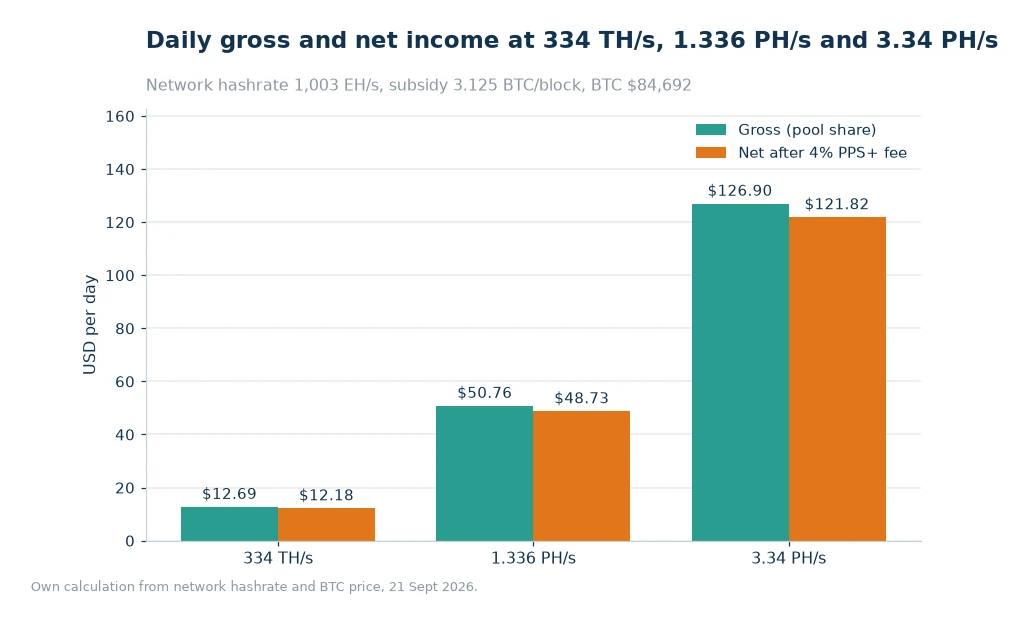
- 334 TH/s credits 0.00014983 BTC a day, $12.69 gross and $12.18 after the listed 4% on the block-reward component.
- 1.336 PH/s is four times that at $48.73 net; 3.34 PH/s is ten times at $121.82 net.
- Coin prices alone cannot rank chains: BTC at $84,692 and KAS at $0.04130647 need their own difficulty and subsidy to be compared.
- LTC and DOGE are mined together, so the DOGE side adds to LTC revenue rather than requiring separate hardware.
One login, several separate ledgers
The pool supports twenty or more coins, among them BTC, BCH, LTC with DOGE through merged mining, KAS, ZEC, HNS, CKB and ETC. Each coin has its own network, its own difficulty and its own issuance schedule, and the pool settles each one on its own terms. A miner who switches a machine from one chain to another is not changing a setting inside a single economy; they are moving to a different economy with different rules.
What stays constant is the account. The same login carries the workers, the payout addresses and the history, and the wallet inside the account can hold more than one currency. That is convenient, and it is also a trap for the careless: a balance that mixes four coins has no single dollar value until each part is priced, and a comparison that treats them as one number will usually flatter whichever coin has the highest unit price.
Why coin price is the worst single input
BTC at $84,692, BCH at $261.48, LTC at $59.32 and KAS at $0.04130647 are prices per coin, not prices per unit of work. Mining rewards depend on how much of a chain's issuance a given hashrate can claim, and that depends on the chain's difficulty and its subsidy. A coin priced at a fraction of a cent can pay more per terahash than one priced in the tens of thousands, and the reverse is equally possible. The unit price alone says nothing.
The second input is the subsidy schedule. Bitcoin issues 3.125 BTC per block across 144 blocks a day, which is 450 BTC. Other chains issue on their own timetables, sometimes far more frequently and in much larger nominal amounts. Comparing a daily coin count across two chains is therefore meaningless; only the dollar figure per unit of hashrate, computed from that chain's own difficulty and subsidy, can be ranked.
Where the comparison can actually be made
The ViaBTC Mining Pool calculator is the practical place to do it, because it takes a coin, a hashrate, the current difficulty and the listed rate as inputs and returns a daily estimate. Run the same hashrate through each candidate chain with that chain's figures and the outputs become comparable, which is the only way a choice between coins can be made on arithmetic rather than on a hunch about price charts.
Two cautions apply to every result. The estimate is a snapshot: difficulty moves on each chain independently, and the reading of minus 2.12% for Bitcoin applies to Bitcoin alone. And the estimate is gross of power, which is identical whichever chain is chosen because the machine draws the same watts. A chain that looks better by a few percent of revenue can still lose to the power bill, and the bill does not care which coin was mined.
The BTC baseline in three sizes
Bitcoin is the reference case because every input is known: 1,003 EH/s of network hashrate, 3.125 BTC per block and 144 blocks a day. The table states the same hashrate at three scales and shows the share of daily issuance each one represents, which is the figure that transfers if the network grows.
| Hashrate | Share of issuance | BTC per day | Gross USD | Net USD |
|---|---|---|---|---|
| 334 TH/s | 0.0000333% | 0.00014983 | $12.69 | $12.18 |
| 1.336 PH/s | 0.0001332% | 0.00059934 | $50.76 | $48.73 |
| 3.34 PH/s | 0.0003330% | 0.00149834 | $126.90 | $121.82 |
The share column is useful for planning beyond the current month. Doubling the hashrate doubles the share; doubling the network halves it. A miner who expects the network to grow can see, in one number, how much extra hardware would be needed just to stand still, and that calculation applies to any chain once its own network hashrate is known.
Worked example
Price the BTC ledger from the network total, then note what a second chain would require.
- Per terahash: 450 BTC a day divided by 1,003,107,267,295 GH/s is 0.00000044861 BTC.
- 334 TH/s: 334 multiplied by 0.00000044861 is 0.00014983 BTC, or $12.69 at $84,692.
- Listed 4%: 0.00014983 multiplied by 0.96 is 0.00014384 BTC, or $12.18.
- Share: 334 divided by 1,003,107,267,295 is 0.000000333, which is 0.0000333% of the network.
- Four times the hashrate: 0.00059934 BTC a day and $50.76 gross, with the share at 0.0001332%.
- Ten times the hashrate: 0.00149834 BTC a day and $126.90 gross, with the share at 0.0003330%.
- A second chain would need the same four steps with its own subsidy and network hashrate, which is why the BTC result cannot be transplanted.
Merged mining and the DOGE question
LTC and DOGE are mined together, which means one submission of work can earn on both chains at once. That is a genuine addition rather than a marketing phrase: the same hashrate that finds an LTC block also carries the merged-mining payload, and the pool credits both sides. The practical question is not whether to mine DOGE instead of LTC, because the choice does not exist; it is whether the combined payout beats a pure BTC payout at the same power cost.
Answering it needs the same discipline as any other comparison: the LTC difficulty, the DOGE difficulty, the LTC price of $59.32, and the pool's listed rate. Anything less is a guess dressed as a strategy. The merged-mining structure does reduce one cost, because the hardware, the power and the rack space are shared, so the comparison is against BTC revenue net of the same watts rather than against a second machine.
Frequently asked questions
Can one account mine more than one coin?
Yes. Twenty or more coins are supported, including BTC, BCH, LTC with DOGE through merged mining, KAS, ZEC, HNS, CKB and ETC, and each worker can be pointed at a different one under the same login.
Should I mine the coin with the highest price?
No. Price per coin says nothing about reward per unit of hashrate, which depends on that chain's difficulty and subsidy, so a low-priced coin can pay more per terahash than a high-priced one.
How much does 334 TH/s earn on Bitcoin?
At 1,003 EH/s, 450 BTC a day and $84,692 per BTC, 334 TH/s earns 0.00014983 BTC daily, or $12.69 gross and $12.18 after the listed 4% on the block-reward component.
Choose with inputs, not headlines
Write the subsidy, the network hashrate, the price and the listed rate for each candidate chain, then run the same four-step arithmetic for all of them. The chain that wins on paper is the one to test, and the test is cheap because switching a worker takes minutes. The Profit Calculator handles the per-chain estimate including merged mining output, and the multi-currency wallet keeps the resulting balances in one place instead of scattered across exchanges.
Sources: the ViaBTC homepage for the supported coin list, merged mining and payout terms, and the calculator page for per-chain estimates[1]. Inputs read 21 Sept 2026: BTC $84,692, LTC $59.32, BCH $261.48, KAS $0.04130647, network hashrate 1,003 EH/s, difficulty 132.76 T, subsidy 3.125 BTC per block, 450 BTC a day. Published 22 Oct 2026. Only the BTC arithmetic is worked here; other chains need their own difficulty and subsidy.